Over The Door Shoe Organizer Heavy
Over The Door Shoe Organizer Heavy
Couldn't load pickup availability

Over The Door Shoe Organizer Heavy
1. Introduction: Shoes on the Floor, Again
Shoes accumulate on the floor with no plan. One pair comes off at the door, another pair sits by the bed, a third lives by the wardrobe, and none of them have a place. A shoe rack helps, but a rack needs floor space, and floor space is the thing small homes do not have.
The other option is the back of a door — a surface that exists in every home and is used for nothing. A door already carries weight, already opens and closes, and already stands where shoes are taken off.
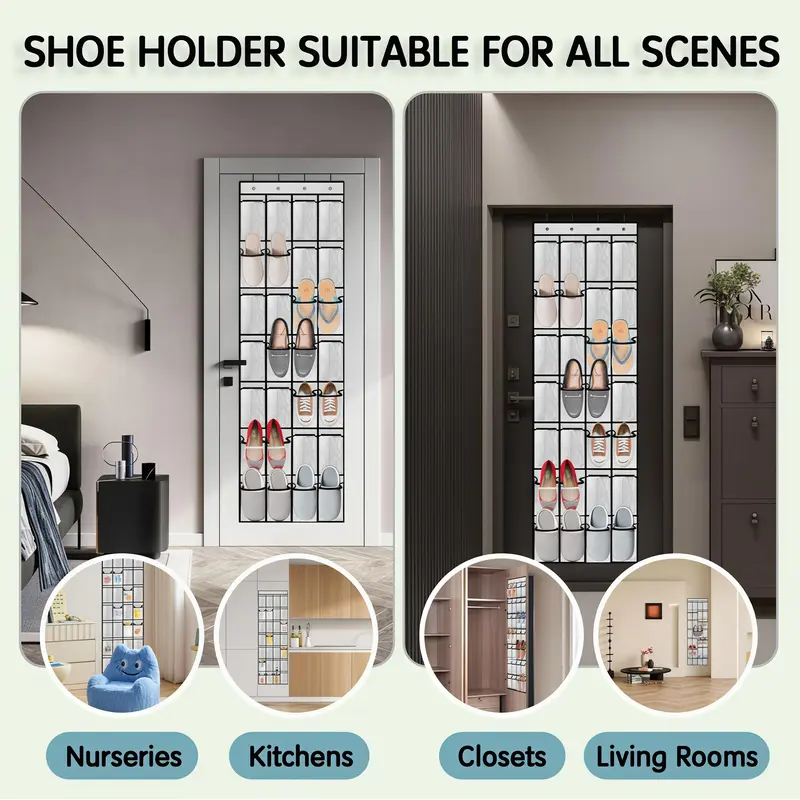
This Over The Door Shoe Organizer Heavy uses that surface. It hangs from the top of a door on hooks, with a white fabric backing and rows of black wire-grid pockets, each pocket sized to hold a pair of flat shoes, sneakers, or slippers. No drilling, no floor space, and no shelf.
It is the shoe storage solution that fits the room people actually have.
2. Design
2.1 The Door-Hung Frame
The organizer hangs from a set of hooks that fit over the top edge of a door. The backing is a panel of fabric, stiffened along the top so it hangs flat rather than sagging, and the pockets are attached to that panel.
Because it hangs on the door rather than the wall, it needs no tools beyond the hooks supplied — which is the reason it can be installed in a rental, moved between rooms, or taken down without leaving a mark.
2.2 The Wire Grid Pockets
The pockets are made from black metal wire bent into a grid: a front grille of vertical and horizontal wires, open at the top, holding a shoe against the fabric behind.
That wire construction does three things. It lets air circulate around the shoe, so trainers do not sit damp in a closed pocket; it lets you see the shoe at a glance through the grid; and it holds the shape of the pocket so it does not collapse when empty.
2.3 The Rows
The organizer is built in rows, one pair per row, stacked down the panel. In the reference styling, shoes are arranged by type — flats, heels, trainers, slippers — a few per row, with gaps filled as the collection grows.
That row structure is what makes it usable: each pair has a position, and the contents are visible without opening a box.
2.4 The Slim Profile
Because the pockets hang flat against the door, the organizer's depth is a few centimetres, which is the whole point of a door-mounted system: it uses depth that a door already occupies, not depth that a room needs.
3. Materials
3.1 The Fabric Backing
The backing is a white fabric panel, stiffened at the top and hemmed at the edges. Fabric rather than rigid board keeps the organizer light and lets it conform to the door, so it does not knock against the surface when the door moves.
White is the practical choice: it disappears against a white door, and it does not show the shadow of the frame.
3.2 The Wire Pockets
The pockets are black-coated metal wire, which is stiff enough to hold a pair of shoes and light enough that the whole organizer stays light. The black coating resists rust in a hallway where umbrellas drip.
The wire ends are rounded where they meet the fabric, so they do not snag a shoe or a hand.
3.3 The Hooks
The hooks are a flat, slim design that fits over the door's top edge, so the door can still close. They are the load-bearing part: the whole organizer's weight hangs from them, which is why the design uses a hook set rather than a single point.
3.4 Capacity and Weight
The organizer is designed to distribute weight across the rows, so the top rows do not pull the panel down. Heavier shoes go on lower rows.
4. How to Use It
4.1 Hanging It
Fit the hooks over the top of the door, then hang the panel. Check that the door still closes fully and that the hooks are not pinched.
4.2 Loading
Place shoes into the pockets with the toe or heel facing out, so each pair reads at a glance. Keep pairs together and group by type: trainers in one run of rows, heels in another.
4.3 Heavy and Light
Put heavier shoes — boots, thick-soled trainers — on the lower rows, where the fabric has support behind it, and lighter shoes above.
4.4 Daily Use
Because the pockets are open grids, shoes are visible and reachable without opening a door to a cupboard. That is what makes the organizer get used rather than filled once.
4.5 Rotating Pairs
Use the organizer as a place for the shoes in current rotation, and move the out-of-season ones to a box. That keeps the door organizer from turning into a permanent store of everything.
5. Placement
5.1 Bedroom Door
On the door of a bedroom, the organizer holds the shoes in daily rotation, off the floor, at the height where they are taken off.
5.2 Entry and Hallway Door
On an entry door or a hallway cupboard door, it holds the shoes coming in and going out, plus slippers and a pair of trainers.
5.3 Closet Door
On a closet door, it uses the space that a closet already occupies and keeps the floor of the closet clear.
5.4 Nursery and Children's Room
In a nursery, the organizer holds small shoes, slippers and booties at a lower height, and in a child's room it works as a place for shoes a child can reach.
5.5 Kitchen and Utility Areas
Because the pockets hold more than shoes, the organizer also works in a kitchen or a utility space for cleaning cloths, sprays, or small items, as in the reference styling.
5.6 Living Room and Small Flats
In a small flat, the back of a door is one of the few storage surfaces that costs nothing, and the organizer makes that surface usable.
6. Fit and Sizing
Measure the door's height and width: the panel hangs from the top edge, so a short door will hang the panel lower, and a narrow door may need the panel to be attached differently.
Check the door's thickness against the hooks: they must fit over the top edge and under the frame, so the door can still close.
Check the clearance behind the door: the organizer needs a few centimetres of space, and a door that opens against a wall very close may press the pockets.
7. Specifications
- Product: over the door shoe organizer, heavy-duty
- Mount: hooks over the top of the door, no drilling
- Pockets: black wire grid pockets on a white fabric backing
- Capacity: one pair per row, multiple rows
- Profile: slim, hangs against the door
- Use: shoes, slippers, small items
- Care: wipe clean; dry before reloading

8. Care
Wipe the fabric backing and the wire pockets with a barely damp cloth, and dry them before putting shoes back. Do not machine wash, which would distort the backing.
Check the hooks and the fabric top edge periodically, since that seam carries the load, and do not overload the top rows.
9. Why Choose This Over a Shoe Rack or a Shoe Cabinet
A shoe rack takes floor space and leaves shoes visible at a low height. A shoe cabinet takes depth, which most small rooms do not have, and needs assembly. A hanging canvas organizer collapses and hides the shoes in pockets.
This organizer uses the back of a door, which costs no floor or wall space; the wire pockets let air circulate and keep shoes visible; and it installs without tools or drilling.
10. Gifting and Practical Use
The organizer suits a student moving into a room, a renter who cannot install shelving, a family reorganising an entryway, or anyone whose shoes have taken over the floor. It is also a cheap way to tidy a closet before a season change.
11. Conclusion
The Over The Door Shoe Organizer Heavy turns the back of a door into shoe storage: a white fabric panel hung from door hooks, rows of black wire-grid pockets, a pair per row, slim enough that the door still closes. It needs no drilling and no floor space, and the shoes stay visible and reachable.
Hang it on the door, load the pairs, and the shoes come off the floor.